The Music City Machine Doesn’t Make Stars. It Sells Archetypes.
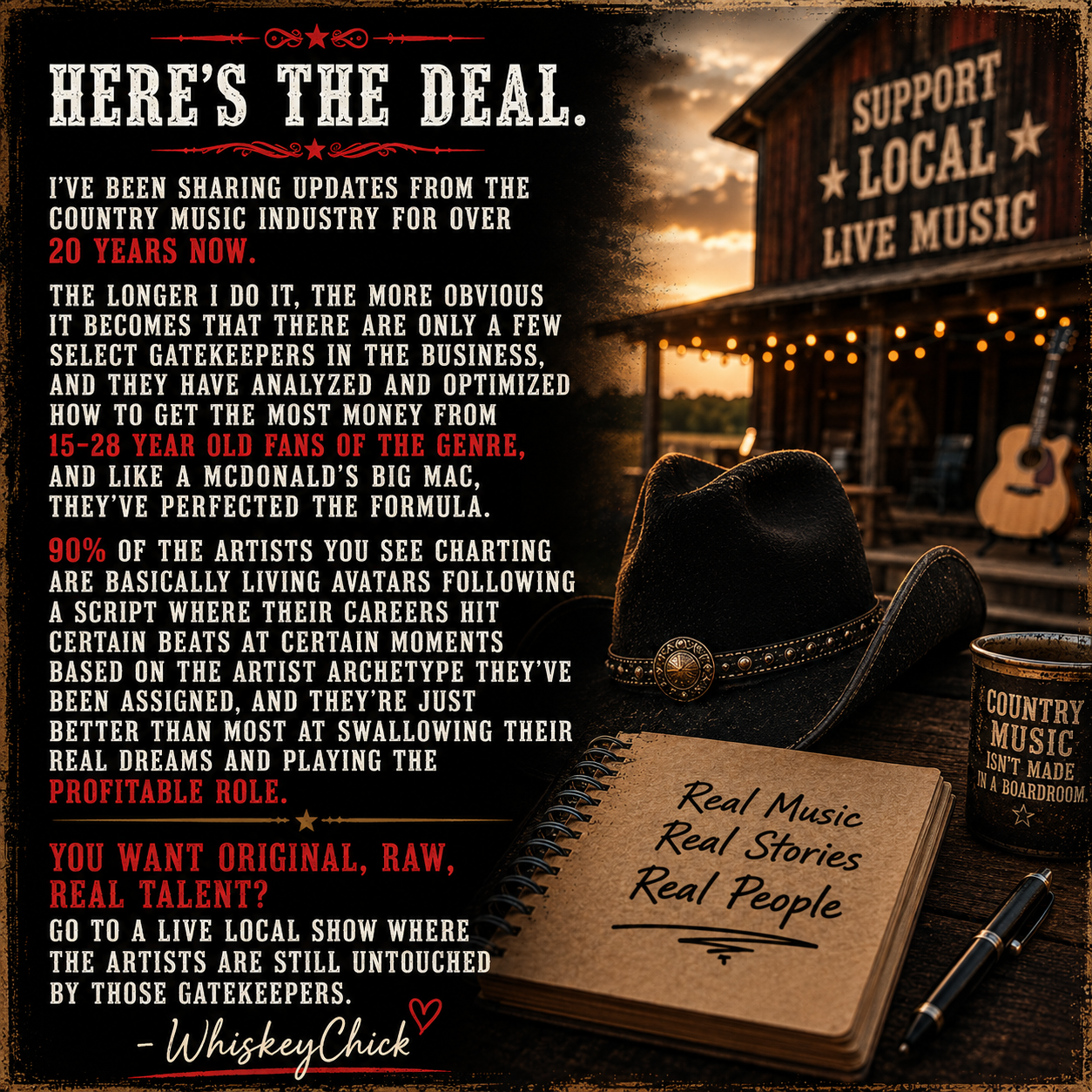
Here’s the deal. I’ve been sharing updates from the country music industry for over twenty years now. My current count has me at almost 8,000 articles published, and in that time certain patterns can’t help but emerge.
When I first started, I thought success came down to writing better songs, putting on better shows, finding the right producer, maybe catching a lucky break. I believed every artist’s path was unique because every artist was unique. The music moved me, and in turn I helped promote that music, and turned it into a career filled with late night dive bars, obsessive research sessions, major festivals and concerts and case upon case of hand-labeled demo cd’s delivered in a PO box downtown for me to preview and review.
Twenty years later, I don’t think that luck theory is entirely true. The longer I do this, the more obvious it becomes that Nashville, like every other entertainment industry, has spent decades studying what audiences respond to, and where they could optimize their earnings. Somewhere along the way, they stopped selling individual musicians and started selling characters.
Archetypes.
McDonald’s didn’t invent the hamburger. They just figured out how to make millions of them taste exactly the same so consumers would get a reliable, predictable product no matter where they were in the world or in life. Country music hasn’t invented every kind of artist either. It’s simply become incredibly efficient at recognizing the personalities audiences already love and turning those traits into reliable careers that align with the consumers tastes and spending habits.
Once you notice the pattern, you can’t stop seeing it.
For example, every generation gets a “Pop-Country Princess”.
She arrives young. She’s approachable. She writes about growing up right alongside her fans. Every album becomes another chapter in her life. Somewhere along the way she experiments with pop, broadens her audience, then eventually reminds everyone where she came from.
The faces change. The blueprint rarely does.
Following our princess around like the proverbial wolf, you get “The Bad Boy”.
Years ago he was called an outlaw. Today the edges are a little smoother, the marketing budget is a lot bigger, and social media has debunked outlaw mythology, but the role is remarkably familiar. Every generation needs the guy who seems just rebellious enough to make suburban parents nervous while still selling out arenas and signing endorsement deals. They get in just enough trouble to create a screw-up, own-it, redemption arc before repeating the cycle.
The rebel has become one of Nashville’s safest investments, because people love trash talking when a celebrity makes a mistake, but then see their own fallible selves in the redemption story.
Then there’s my favorite archetype.
The “I’m Just Lucky To Be Here” artist.
You know the one… the artist who seems genuinely surprised anyone is paying attention. They’re self-deprecating. They never seem entirely comfortable being famous. They still talk about playing bars, driving old trucks, or sleeping in vans. Whether it’s completely authentic or simply the most honest part of who they already are, audiences love humility. We root for people who look like they could still be standing next to us in line at the feed store. You root for them like the underdog in a competition.
Then you get “The Savior”.
The headlines practically write themselves. “Finally… real country is back.”
Sometimes it’s true. Sometimes it’s nostalgia wearing a new hat. Either way, there’s always room in the marketplace for an artist positioned as the antidote to whatever country music supposedly became last year. They give us a touch of safety as we age up, saying “you’re not getting old, we still make music the way you’re used to”. They pass on obvious over-production in favor of more pronounced banjos and steel guitar in the mix. They keep the Stetson on instead of a ballcap.
Then there are “The Country Intellectuals”.
These are the critical darling artists who make albums journalists adore, musicians respect, and fans defend like they’re protecting a family secret. Their authenticity becomes part of the story. Their experimentation and careful storytelling help push the genre forward, singing about controversial topics, and using boundary-pushing visuals without losing its’ foundation. Ironically, authenticity itself eventually becomes another lane the industry knows how to market.
That’s the funny thing about The Machine.
It doesn’t necessarily create personalities. It recognizes them, then it amplifies them. It sands off the rough edges that don’t test well. It doubles down on the traits that do.
By the time millions of people know an artist’s name, they’re often seeing the cleanest, simplest version of a much more complicated human being.
And it isn’t just personalities. Watch enough careers and you’ll notice they tend to hit familiar milestones, too.
- The breakout single.
- The award show breakthrough.
- The crossover collaboration.
- The carefully timed acoustic record.
- The “back to my roots” album.
- The Christmas album.
- The documentary.
- The arena tour.
- The residency.
Not every artist follows the same roadmap, but enough of them do that it starts feeling less like coincidence and more like an industry that’s gotten very, very good at repeating what works. Of course throw in a few arrest records, a marriage and divorce, and maybe even a disco album so we can say their path really had some bumps, but the rest you can set a calendar by.
Imagine trying to market 500 completely unique personalities every year. You can’t. But if consumers instantly recognize an archetype, marketing becomes easier. The Pop Princess attracts one audience. The Bad Boy attracts another. The Traditionalist reassures older listeners. The Intellectual gives critics someone to champion. It’s segmentation, not unlike any other consumer brand.
None of this means the artists aren’t talented. Far from it. The people who make it to the top are almost always exceptional singers, writers, entertainers, or performers. Talent gets them into the room.
The Machine simply decides which version of that talent the public gets to know.
Maybe that’s the deal.
Maybe every successful entertainment industry eventually becomes a storytelling business more than a music business. Stories and their characters are easier to market than complicated human beings.
But every once in a while, someone slips through. An artist who refuses to fit neatly inside a category. Someone whose career feels less like a product launch and more like a convergence of perfect circumstances mixed with hard work.
Those artists remind me why I fell in love with country music in the first place. Not because they fit an archetype. But because they don’t.
So here’s my question; Which artists do you think found success without signing up to be part of The Machine? Not just artists you enjoy. Artists who genuinely seem to have remained themselves.
And did you automatically think of your favorite artist when you read some of the archetypes above?